Edocti Training
DevOps Fundamentals for Managers
Scheduled sessions
No sessions are available at the moment.
Skills You Will Learn
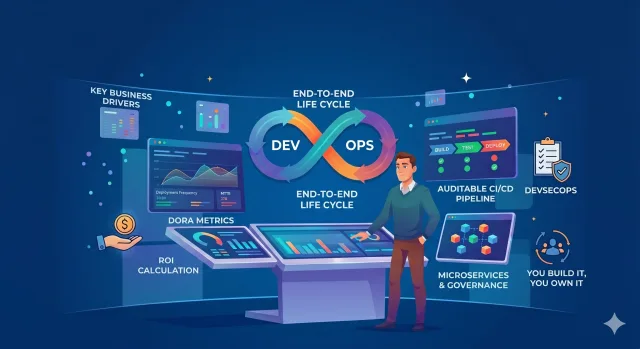
DevOps Culture & Mindset
Microservices Governance
Cloud Cost Management (FinOps)
CI/CD Pipeline Interpretation
DORA Metrics Management
DevOps ROI Calculation
End-to-End Agility Traceability
DevSecOps Compliance Gates
Curriculum
Mindset, Culture & Shared Responsibility
- DevOps as a business philosophy: breaking down organizational silos (Dev vs. Ops) to accelerate Time-to-Market
- The end-to-end lifecycle: mapping the value stream from initial planning through to live production monitoring
- Governance and roles: redefining the RACI matrix and managing cross-functional team dynamics
- Anatomy of a project in crisis: identifying management red flags (nightly deployments, deployment fear, lack of environments)
Modern Architecture & Microservices Paradigm
- Monolith vs. Microservices: why traditional large architectures bottleneck delivery and how modern systems solve it
- The 'You build it, you run it' philosophy: understanding DevOps as a role or mindset embedded directly within developers
- 100% Team Ownership: empowering engineering teams to fully own, understand, and run everything within their specific microservice
- Interactive diagnostic workshop: mapping out current project structures and highlighting existing organizational pain points
Toolchain: Code, Integration & Continuous Delivery
- Version Control (The Source of Truth): Azure Repos / AWS CodeCommit; why delayed code integration poses a severe management risk
- The Developer Workflow Demystified: interactive CLI demo of the daily coding process (git clone, git add, git commit, git push, git pull) to understand technical terminology
- Continuous Integration (CI): Azure Pipelines / AWS CodePipeline acting as the digital assembly line
- Demystifying the pipeline: how to read, interpret, and judge a pipeline's health and predictability without looking at code
Toolchain: Containers, Infrastructure as Code & Security
- Containerization simplified: Docker & Kubernetes concepts and how they eliminate 'it works on my machine' environmental issues
- Infrastructure as Code (IaC): Terraform & ARM Templates (Azure) / CloudFormation (AWS); shifting server provisioning timelines from weeks to minutes
- DevSecOps (Security from Day One): automated security gates, understanding SonarQube quality criteria and Snyk vulnerability gates
Hands-on Governance Labs: UI Flow & Pipelines
- Lab 1: Flow management in the UI — understanding Pull Requests, performing management code reviews, and handling graphical release approvals (Azure DevOps / GitHub)
- Lab 2: Visualizing a CI/CD pipeline — tracking build stages, investigating failures, and locating delivery bottlenecks autonomously
Hands-on Governance Labs: Cloud Cost Control & Quality
- Lab 3: Financial Control Dashboards — creating and interpreting cost dashboards (Azure Cost Management / AWS Cost Explorer) to monitor daily burn rates and resource group budgets
- Lab 4: Quality auditing & Health — reading SonarQube technical debt metrics, interpreting system alerts, and prioritizing security issues in the backlog
- Lab 5: End-to-end traceability — mapping user stories from Azure Boards / Jira directly to live production deployments for audit trails
Cloud Governance, FinOps & Metrics Assessment
- FinOps basics: tracking cloud budgets, understanding unexpected cost spikes, and implementing resource rightsizing governance
- The Strategic Diagnostic Framework: 10 key governance questions every non-technical manager must ask their technical leads
- DORA Metrics (The Industry Gold Standard): measuring Deployment Frequency, Lead Time for Changes, MTTR, and Change Failure Rate
- Practical Workshop: conducting a real DevOps Maturity & Cost Efficiency Assessment on the participants' current active projects
Business Case, ROI Calculation & Action Plan
- Calculating DevOps ROI & Cost Efficiency: formulas for quantifying manual task reduction and cloud cost savings vs. the upfront costs of automation engineering
- Building the Business Case: selling DevOps internally to leadership or externally to stakeholders as a risk-mitigation and cost-control strategy
- DevOps in the Sales Process: successfully embedding DevOps activities, cloud budgets, and modern estimation models into Statements of Work (SoW)
- Capstone Workshop: formulating and presenting a customized, one-page DevOps Action Plan for a real project, ready for immediate rollout
Optional modules
Optional — Advanced Service Management Alignment
- Change Management alignment: bridging the gap between traditional ITIL Change Advisory Boards (CAB) and rapid automated deployments
- Site Reliability Engineering (SRE) introduction: understanding Error Budgets and Service Level Objectives (SLOs)
Course Day Structure
- Part 1: 09:00–10:30
- Break: 10:30–10:45
- Part 2: 10:45–12:45
- Lunch break: 12:15–13:15
- Part 3: 13:15–15:15
- Break: 15:15–15:30
- Part 4: 15:30–17:30